Solve a Sudoku by following the energy downhill
Sudoku-Extreme, ~56 blanks per puzzle, valid-or-not is unambiguous.
Fill a partly-blank grid so every row, column, and box holds 1–9 exactly once.
Sudoku-Extreme, ~56 blanks per puzzle; valid-or-not is unambiguous.
If the energy is a near-perfect verifier, a generator can be trained to descend it to valid completions.
And ideally generalize the RULE to unseen puzzles.
Energy is the judge, the GRAM generator is the player, pathwise sends −∇E into the player; the judge never changes.
Energy = a conv net reading each cell + clue + digit into one number, DSM-trained then frozen. GRAM is recursive: keeps an answer + a scratchpad, nudges toward lower energy over cycles, decodes a digit per cell.
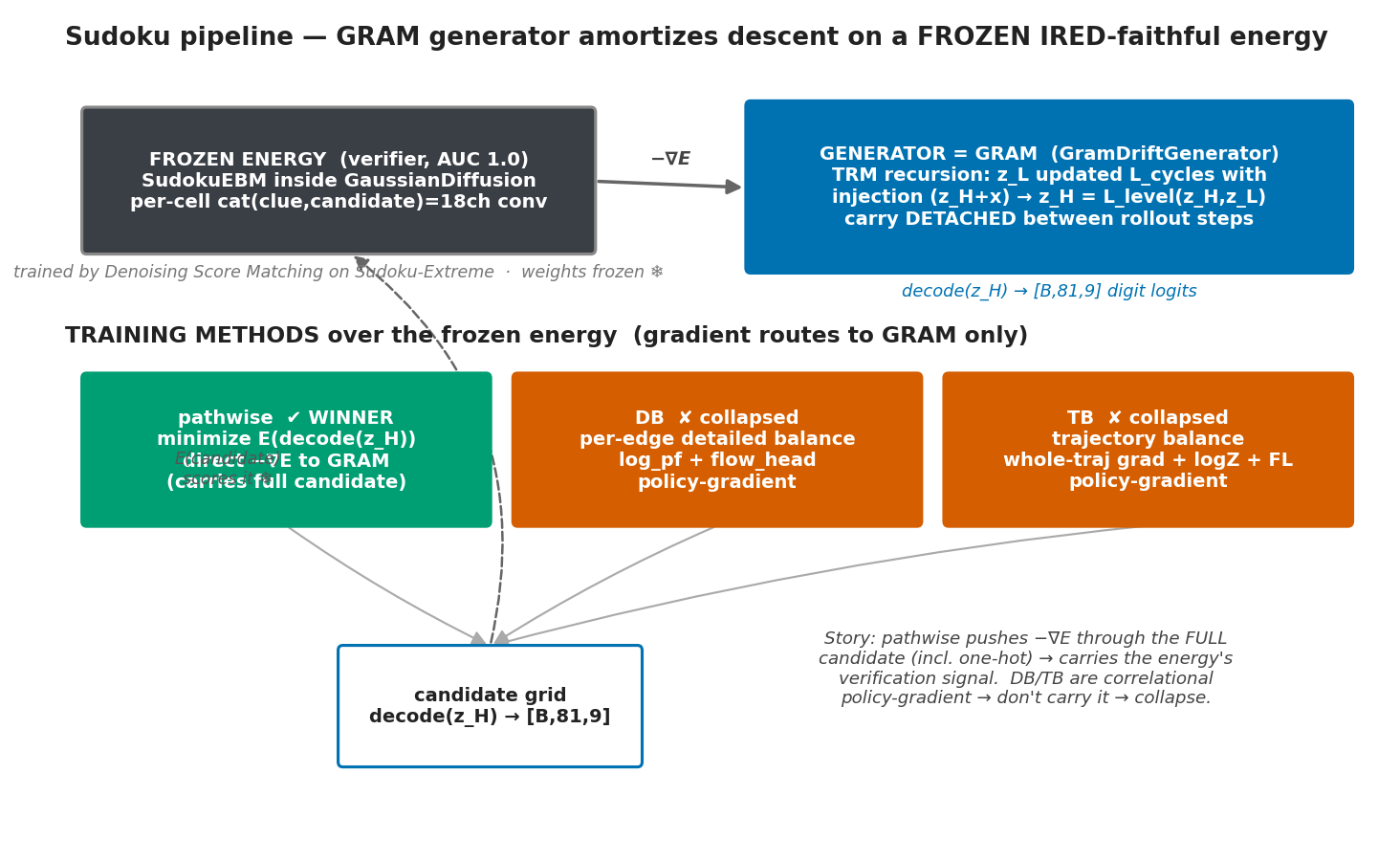
The generator solves its TRAINING puzzles per-cell near-exact; generated grids score E ~571 ~ gold 556.
Verifier is correct on HELD-OUT too (AUC 1.0). Open: does the generator reach brand-new puzzles?
| What | Result | Note |
|---|---|---|
| Energy sanity | 556 < 891 | gold below random — healthy judge |
| Score-matching loss | 0.694 → 0.017 | converges |
| Verifier AUC (held-out) | 1.0 | perfect valid / invalid separation |
| Generator on training | ≈1.0 | solves; generated E ~571 ~ gold 556 |
| Generator on brand-new puzzles | open | the data-efficiency question |
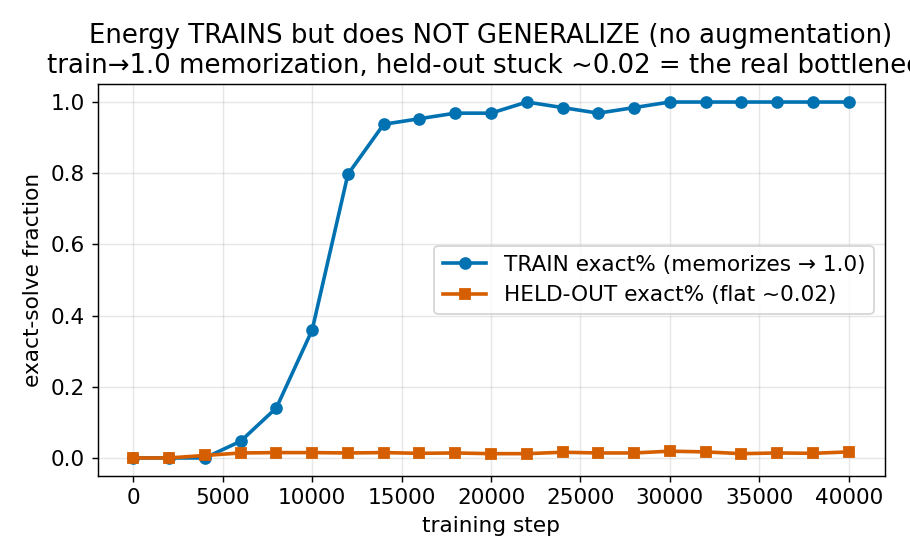
A perfect verifier does NOT imply the generator can REACH good solutions; the train-vs-held-out gap is the data-efficiency question.
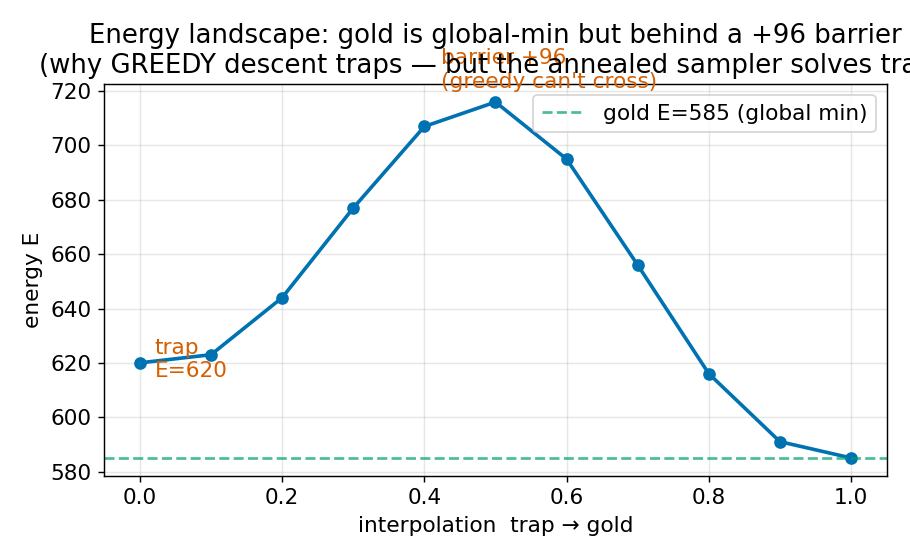
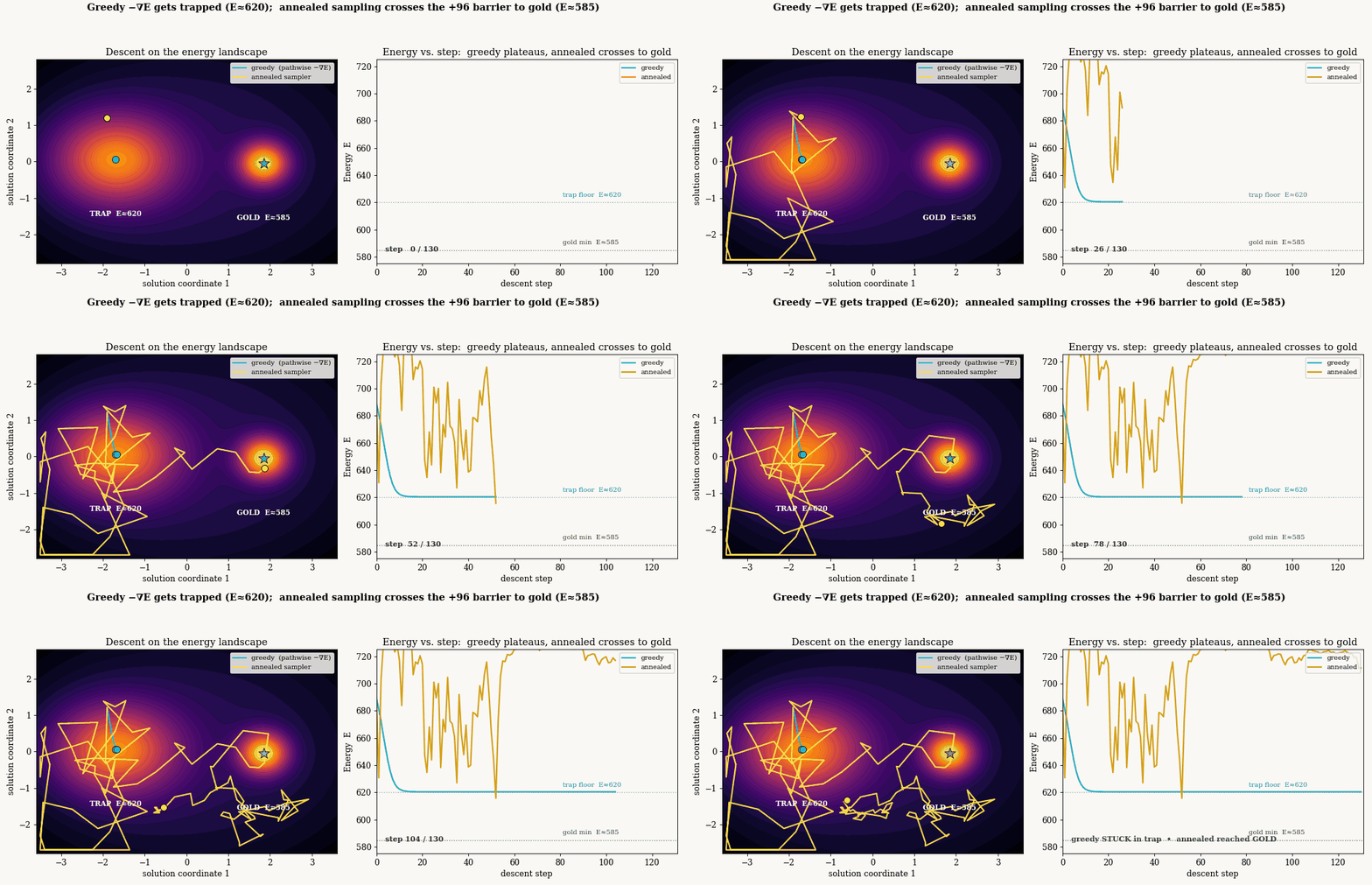
Greedy stalls in a nearby trap; high noise flattens the barrier so the annealed run crosses to gold, then the surface sharpens back.