⚠ ARCHIVED SNAPSHOT (2026-06-26) — this describes the now-SUPERSEDED "descend the energy" thesis, later found to be a dead gradient path. See the latest: /2026-07-06/

Generate good solutions by following a learned ruler downhill

An energy-based recursive generator (GRAM), shown on Sudoku and on crystals with a target band gap.

1.0
Verifier AUC
≈1.0
Sudoku exact (train)
0.97
Crystal validity
1.63 eV
Band-gap err (was 2.96)
✓ works energy is a near-perfect judge (train + held-out); pathwise reliably solves trained tasks ✗ open generalization to brand-new sudoku puzzles · crystal band-gap precision vs 0.3-0.7 eV baselines
Intent

Generate a candidate that satisfies a goal, data-efficiently — no millions of labels.

Studied on Sudoku (rule-valid completion) and Crystal (structure with a target band gap).

Hypothesis

A strong learned energy — a "ruler" — can drive a recursive generator downhill to good solutions.

Method

Energy is the judge, the generator is the player, pathwise training moves the player the way the judge rewards.

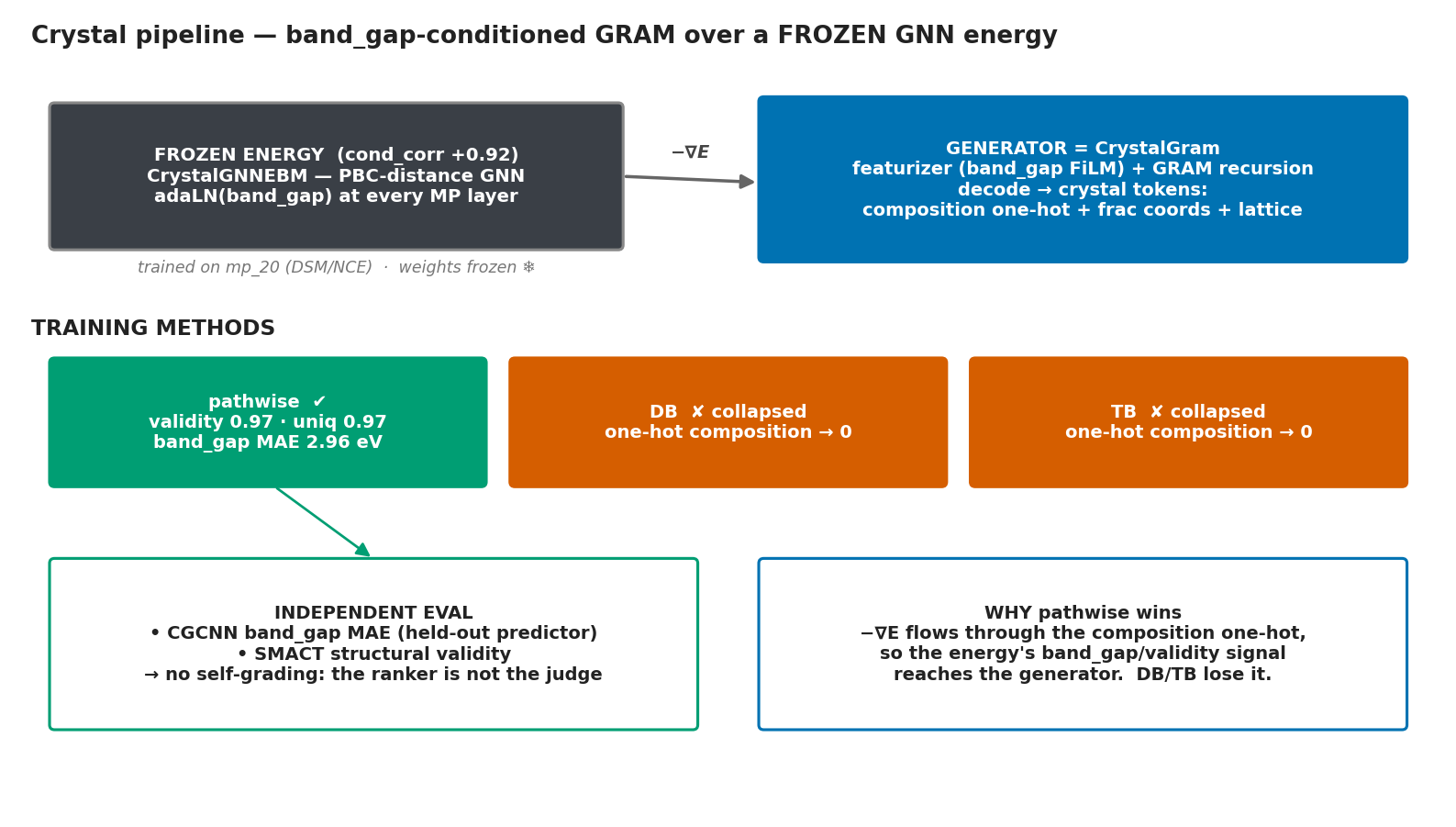
Energy ❄ frozen −∇E downhill Generator GRAM produces candidate solution judged again — energy never changes
Energy
learned scorer, low = good (denoising score matching)
GRAM
recursive generator, refines toward lower energy
pathwise
send −∇E straight in, energy frozen
Why anneal

A learned energy is bumpy (traps), so walking straight downhill gets stuck — annealing smooths them away first.

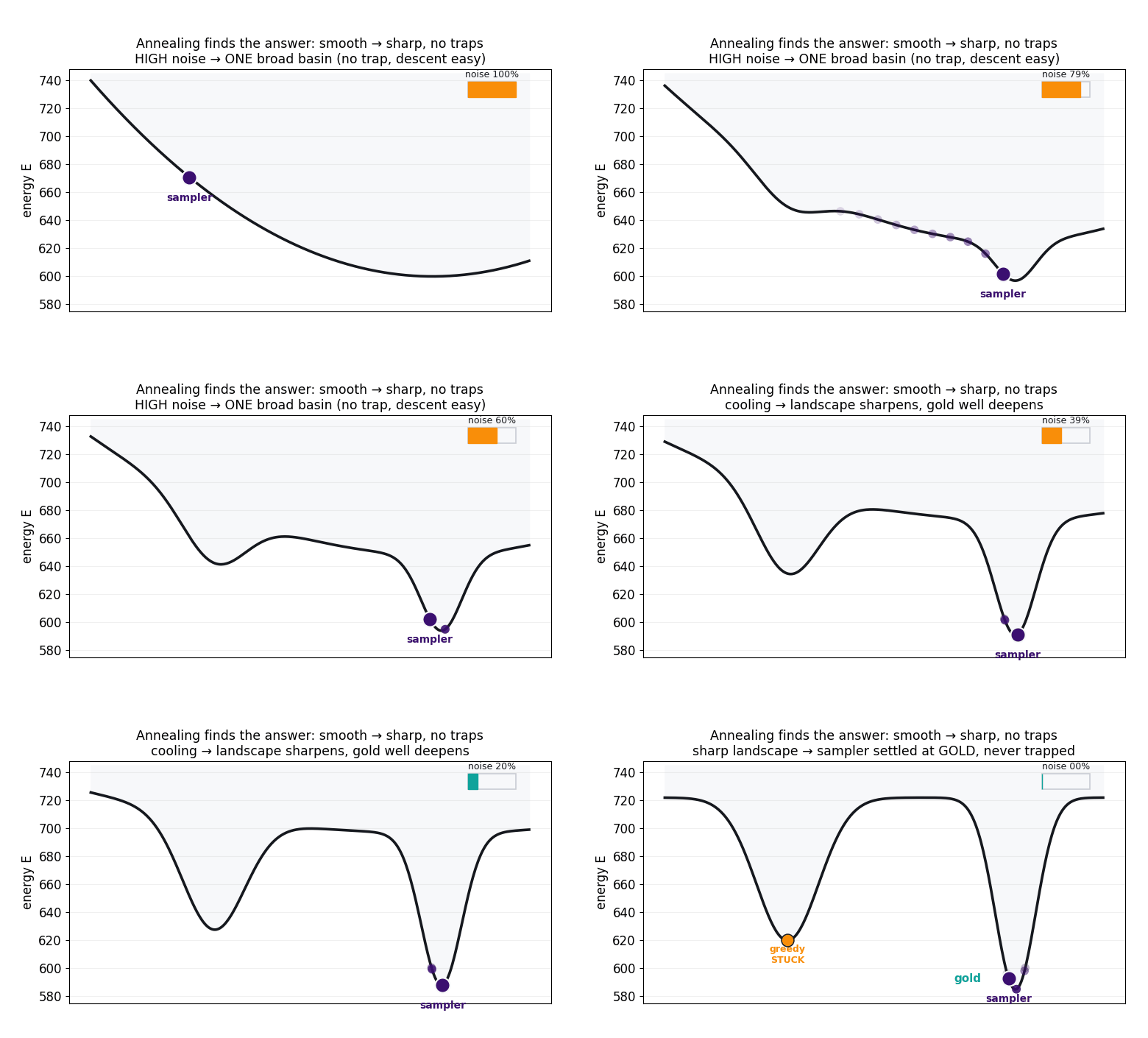
High noise → one broad basin → cool to the global-min "gold" (same idea as IRED).
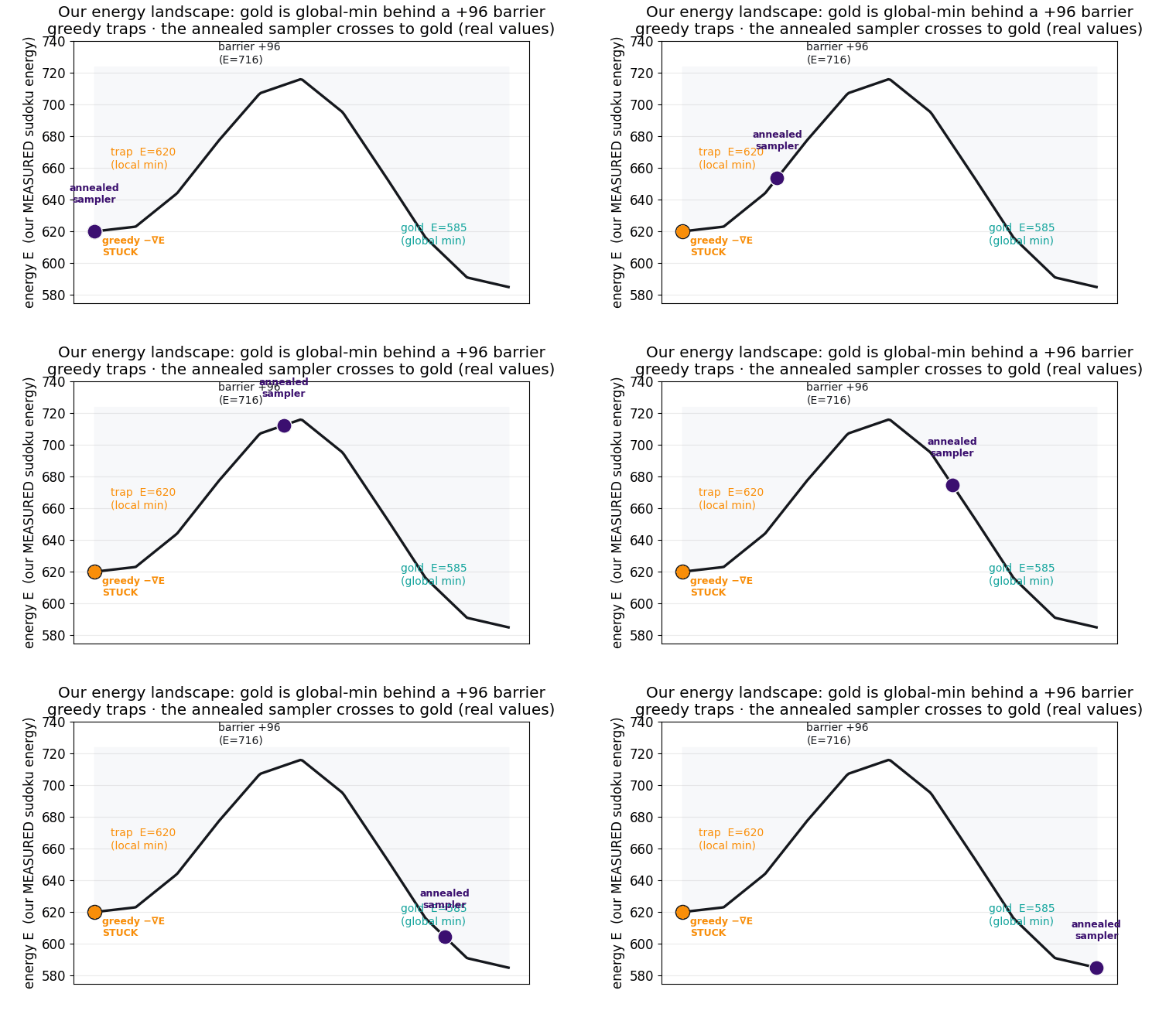
energy trap barrier gold greedy annealed sharp surface — greedy is trapped high noise smooths it flat — annealed crosses the barrier
High noise smooths the energy into a single broad basin, then cooling sharpens it back.
The key intuition. High noise smooths the energy into one broad basin; cooling sharpens it back and the sampler settles in the global minimum.
Greedy descent stalls in a trap; the annealed sampler reaches the global minimum on the real measured energy.
Descent on the real measured energy. Greedy stalls in a nearby trap; the annealed sampler reaches the global minimum.
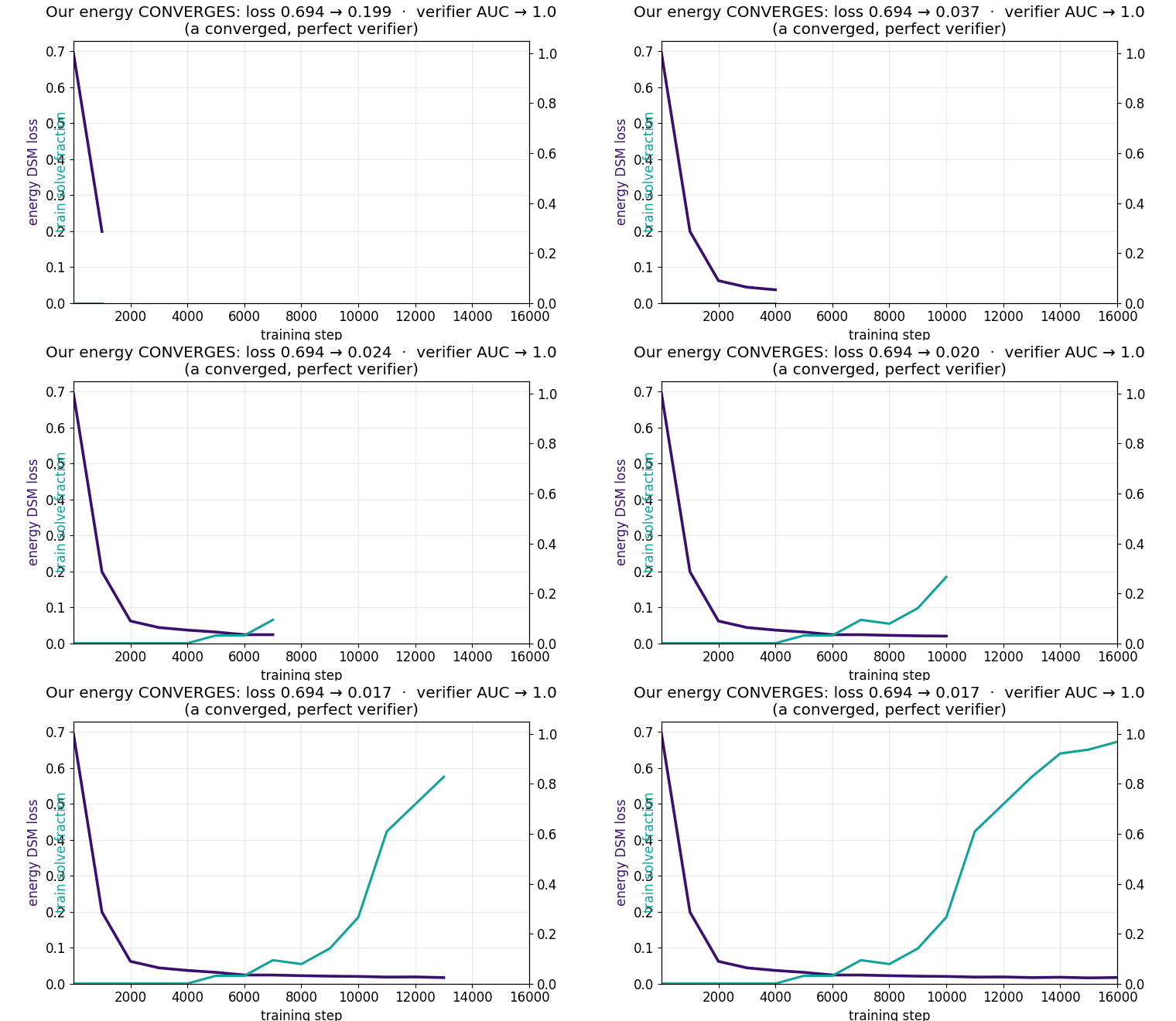
Score-matching loss falls and the energy becomes a reliable judge.
The energy becomes a reliable judge. Score-matching loss falls 0.694 → 0.017; verifier AUC 1.0.
Result

Verifier AUC reaches 1.0; the generator solves the puzzles it is trained on.

Score-matching loss falls 0.694 → 0.017.
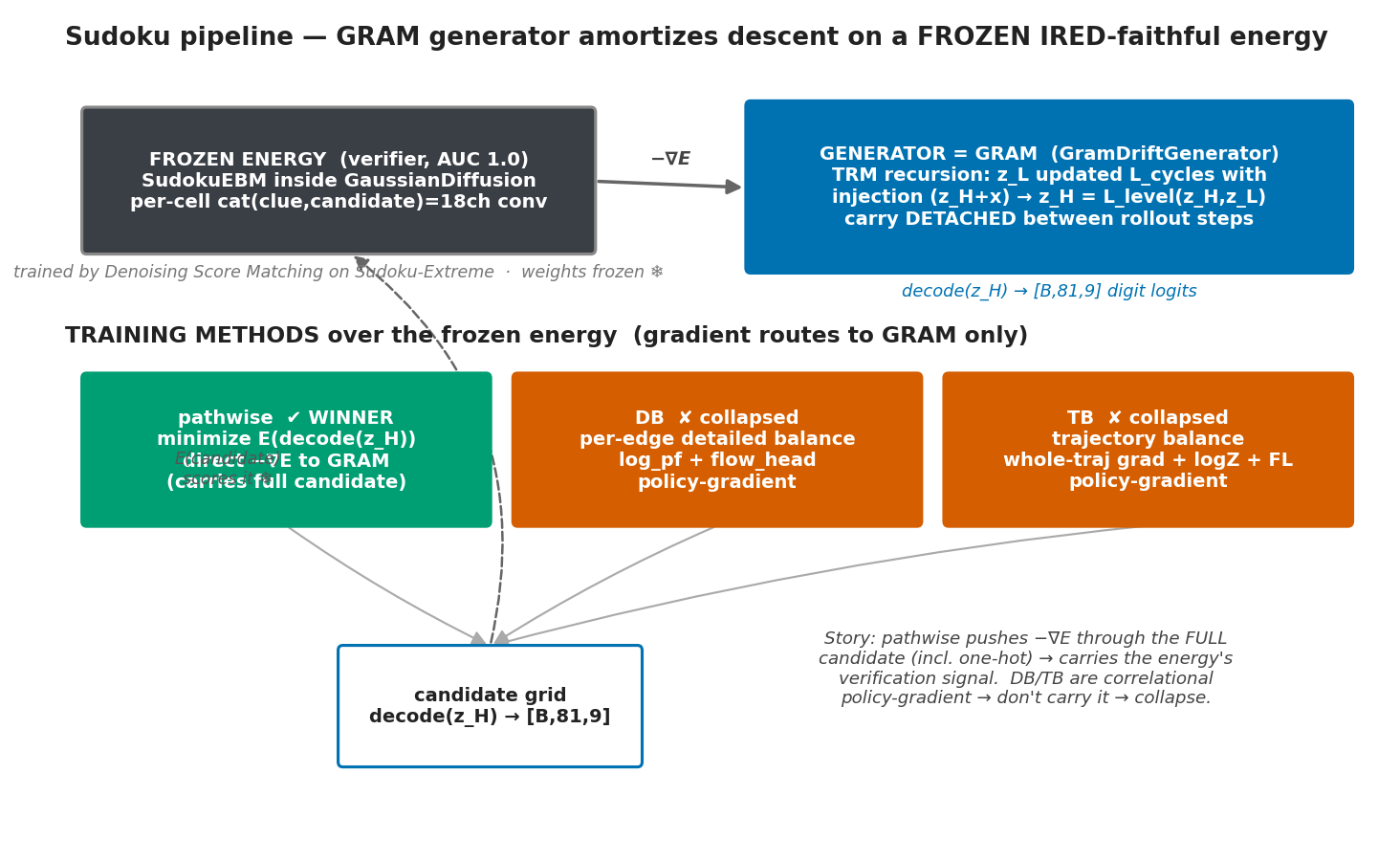
Sudoku module: frozen energy drives the GRAM generator.
Sudoku → solves training (exact ≈1.0), verifier AUC 1.0 held-out. Open: brand-new puzzles.
Crystal module: energy reads structure and band gap.
Crystal → validity 0.97, uniqueness 0.97, band-gap err 2.96 → 1.63 eV with conditioning.
WhatResultNote
Verifier AUC (train + held-out)1.0near-perfect valid / invalid separation
Sudoku exact (train)≈1.0pathwise solves trained puzzles
Generator on brand-new puzzlesopenthe data-efficiency question
Crystal validity · uniqueness0.97 · 0.97structures are valid and distinct
Crystal band-gap error2.96 → 1.63eV, with conditioning
Why pathwise

Pathwise (direct −∇E) beat sampling-based reward methods in our experiments — so it is the method shown throughout.

Honest status. Near-perfect judge on train + held-out; pathwise solves trained tasks. Open: generalization to new sudoku puzzles, and crystal precision toward 0.3-0.7 eV baselines — we do not beat those baselines yet, and say so plainly.